
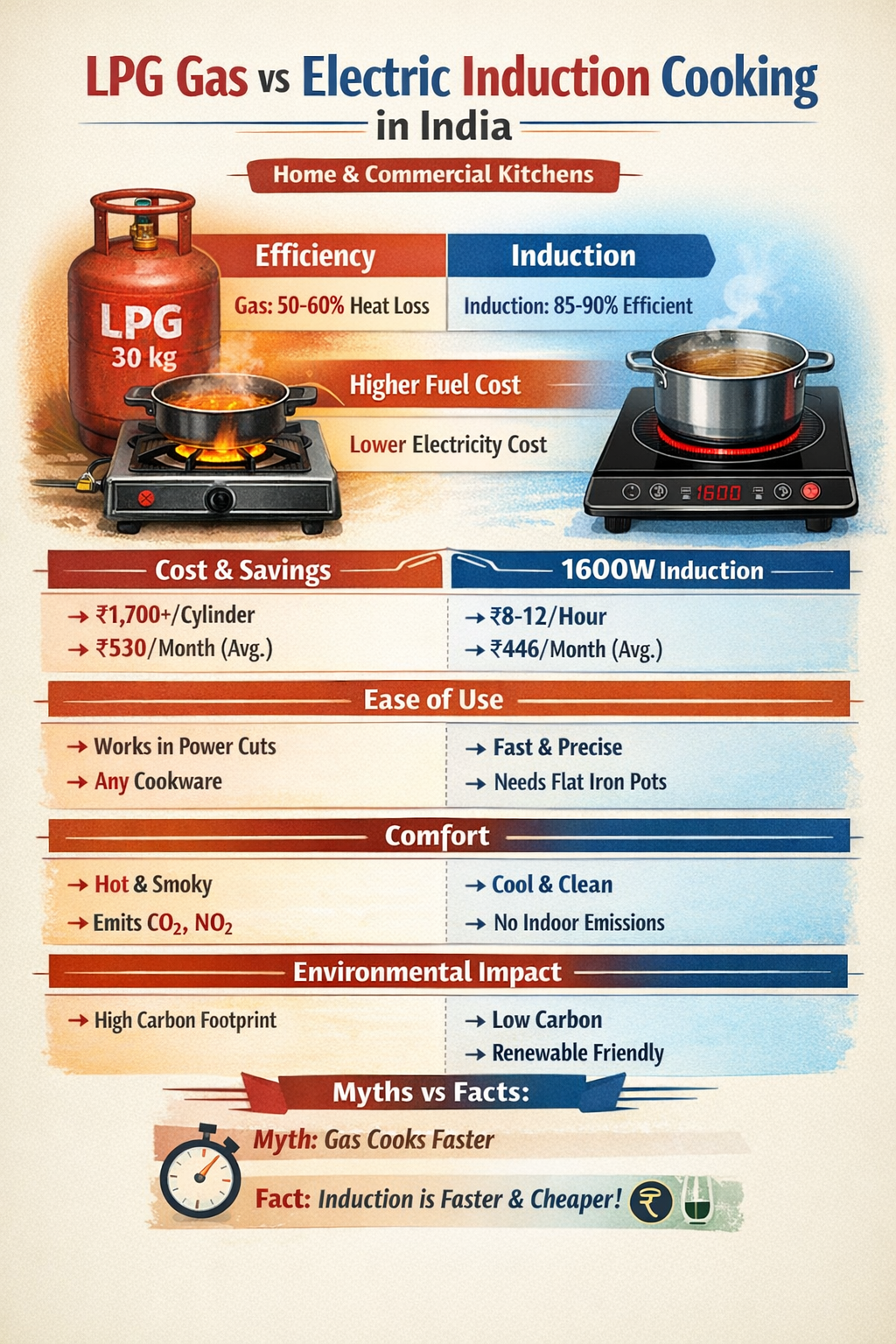
Energy Efficiency: Induction cooktops convert a much higher fraction of energy into pot heat than open-flame LPG. Typical modern induction hobs achieve ~85–90% thermal efficiency[1], whereas LPG burners convert only ~50–60% (even high-end stoves are ~68–76% efficient under India’s new star-label standards). In practice this means induction heats faster: for example, 1 L water boils in roughly 5–7 minutes on induction vs ~10–15 minutes on gas (about 2× faster). A summary is shown below:
Cost & Savings: Fuel prices and efficiency drive the economics. In 2025–26 a 19 kg commercial LPG cylinder costs roughly ₹1,650–1,850 (e.g. Delhi ~₹1,691)[6], ~₹90–95 per kg. Electricity tariffs vary (₹5–10/kWh for domestic users), so 1 hour of 1.6 kW cooking costs roughly ₹8–16. Combined with efficiency, several analyses find induction cooking cheaper in operation. For example, CEEW modeled a typical urban family: monthly LPG fuel ~₹530 vs induction ~₹446 (a ~16% saving). Likewise, IEEFA reports e-cooking in FY2024–25 was 37% cheaper than unsubsidized LPG[8] (and still ~10% cheaper even accounting for LPG subsidies). A comparison table:
*Estimated “exclusive cooking” cost under typical usage.
Although induction units cost more upfront, the extra ₹3,000–5,000 often pays back in a few years through fuel savings. Commercial LPG is additionally taxed (e.g. 5–8% import duty/excise that domestic LPG avoids), raising restaurant gas costs. In contrast, induction requires only wiring and no fuel deliveries. We found no recent Government data specifically on 30 kg cylinders, but the above reflects major metros’ pricing.
Ease of Use: Gas stoves are familiar and instantly intuitive (flame height knob, any cookware, works in power cuts). Induction cookers heat very fast with precise temperature control (often 1°C increments); modern units auto-stop when a pot is removed for safety. Drawbacks: induction needs flat, magnetic-bottom pots (stainless steel or cast iron); lightweight induction-compatible pans are now widely available. Cleaning is simpler on induction (smooth top, just wipe) vs scrubbing burners. Some users notice a faint humming at high power on induction, but otherwise it’s silent. Overall, induction has virtually no flame hazards – it stays cool unless a pan is on it – whereas gas carries risks of leaks or burns. Training curve is small: many Indian dishes (steaming, stir-fry, curries) cook equally well or better on induction (special tavas and high-power burners are available for dosas, biryanis, etc.).
Comfort & Kitchen Environment: Induction keeps the kitchen far cooler. Because heat goes into the pan, very little heats the air. LPG flames, by contrast, shed waste heat (and humidity) into the room, which in India’s heat can make kitchens uncomfortable. Induction also improves indoor air quality: there is no combustion, so no indoor NO₂, CO, soot or volatile organic compounds. (By contrast, studies show even gas cooking briefly spikes indoor NO₂ and emits formaldehyde/benzene.) In hot climates or poorly ventilated kitchens, removing the gas flame significantly cuts perspiration and stove-side heat stress. Gas has one comfort advantage: it works during power outages, whereas induction needs electricity (few models have battery backup).
Environmental Impact: LPG is a fossil fuel – burning 1 kg emits ~3 kg CO₂. Induction cooking’s carbon footprint depends on India’s grid (presently partly coal‐based), but it is inherently more efficient and can run on renewable power (e.g. rooftop solar). As the grid decarbonizes, switching from LPG to electricity can drastically cut emissions. CEEW notes e-cooking “offers an opportunity to decouple cooking from carbon emissions” with a renewable grid, and that a fully carbon-free grid would make electric cooking imperative for low emissions. In short, induction aligns with India’s clean energy goals (higher renewables share) and avoids all indoor air pollutants from fuel combustion. LPG, even with subsidies, remains an import-dependent fuel (costly and carbon-intensive).
Myths vs Facts: A few misconceptions persist. “Gas cooks faster.” In reality, induction often boils water and simmers stews faster (studies show ~50% reduction in cooking time). “Induction raises the electric bill.” Counter: modern induction’s high efficiency means per meal cost can be lower – IEEFA found e-cooking 10–37% cheaper than LPG. “Electric cooking isn’t safe.” Fact: Induction’s surface is cool to touch when off and has no open flame; the main risks with gas (leak/explosion) are absent[18]. “No flame means no flavor/tradition.” While true that tandoor/char may need flame, many Indian dishes have been adapted (e.g. concave induction tawas for dosas). “Power cuts will stop my cooking.” Urban grids now average ~23–24h supply, so outages are rare; plus, LPG kitchens can always simmer on induction backups or portable gas. In short, evidence shows induction’s efficiency, safety and clean-air benefits outweigh its downsides in both homes and small kitchens; LPG remains familiar but brings wasted heat, pollutant emissions and higher fuel costs (especially for commercial setups).
Sources: Data from Indian energy agencies, research (CEEW, IEEFA), and industry reports[2][26][1][9][6][14][20][22]. Tables incorporate efficiency ratings and price lists.
[1] [10] [25] From connection to consumption: Why India’s clean cooking revolution must be electric | IEEFA
https://ieefa.org/resources/connection-consumption-why-indias-clean-coo…
[2] AC-type efficiency star ratings now for LPG stoves - The Tribune
https://www.tribuneindia.com/news/india/ac-type-efficiency-star-ratings…
[3] [7] [22] [23] [26] ceew.in
https://www.ceew.in/sites/default/files/ceew-study-on-clean-electric-co…
[4] [5] [11] [12] [15] [16] [17] [18] Induction Cooktop vs Gas: Which is Better for Your Kitchen? – Stahl Kitchens
https://stahlkitchens.com/blogs/news/induction-vs-gas-cooktop?srsltid=A…
[6] Commercial LPG cylinder gets costlier by Rs 111 in metros; check new prices for Delhi, Mumbai and more - The Economic Times
https://economictimes.indiatimes.com/industry/energy/oil-gas/commercial…
[8] [9] [24] Electric cooking in India 37% cheaper than LPG, 14% cheaper than PNG: Policy action can scale adoption | IEEFA
https://ieefa.org/articles/electric-cooking-india-37-cheaper-lpg-14-che…
[13] How Electric Cooking Can Help Indian Families Transition To Cleaner Fuels
https://www.indiaspend.com/earthcheckindia/how-electric-cooking-can-hel…
[14] Commercial Gas Price in India 17 Jan 2026
https://www.bankbazaar.com/gas-connection/commercial-gas-price-india.ht…
[19] Induction vs Gas Stoves - Which is best Choice for Your Restaurant
https://commercialinduction.in/induction-vs-gas-stoves-which-is-better-…
[20] [21] Clearing the Air: Gas Stove Emissions and Direct Health Effects - PMC
https://pmc.ncbi.nlm.nih.gov/articles/PMC10901287/