
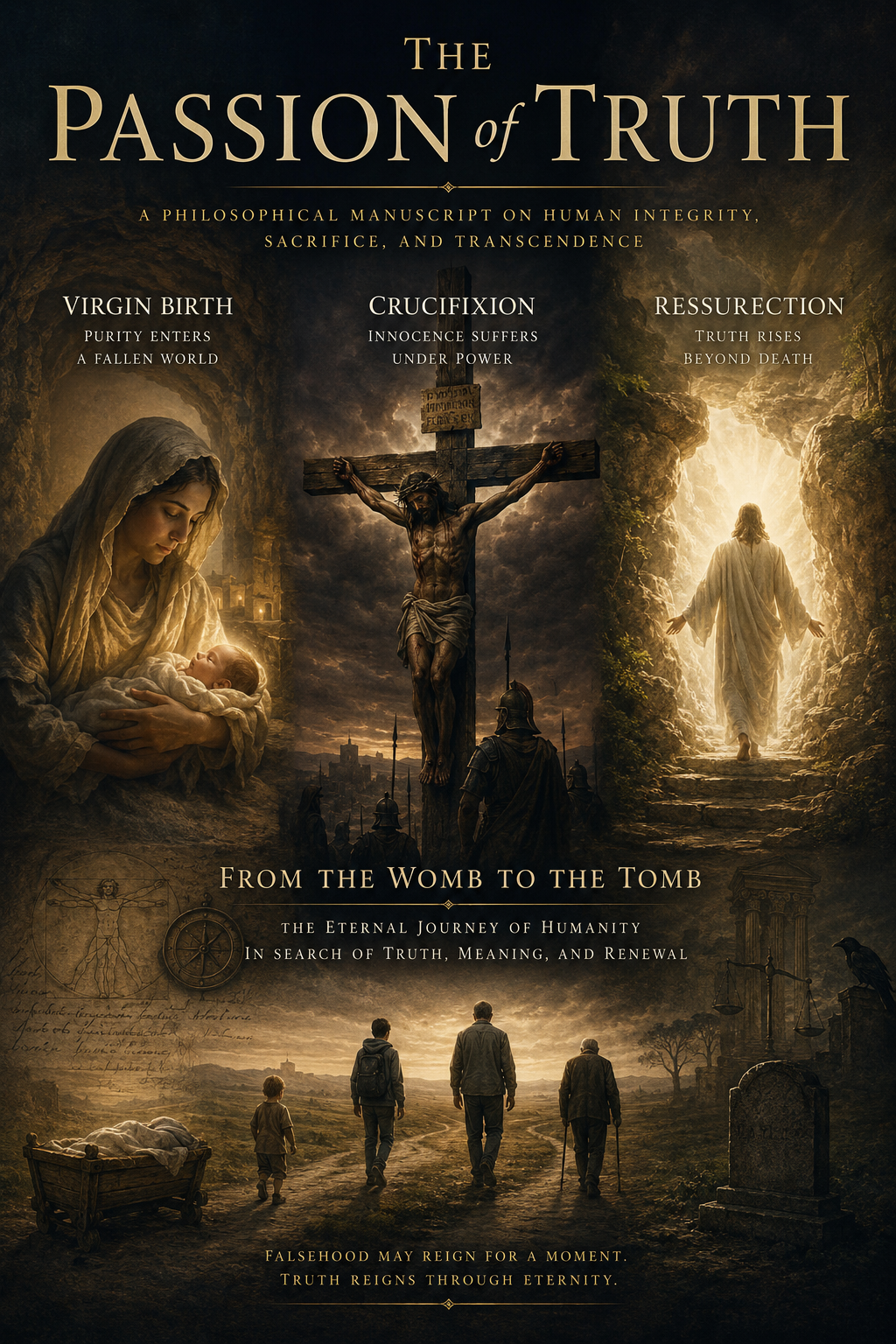
The Passion of Truth
A Philosophical Manuscript on Human Integrity, Sacrifice, and Transcendence
Prologue
Truth is rarely rejected openly.
More often, it is diluted, negotiated, postponed, or sacrificed for comfort and advantage.
Human civilization survives not merely through commerce, power, or intelligence, but through its relationship with truth. Every law, institution, culture, and spiritual system ultimately reflects what a people are willing to believe, defend, or deny.
The crisis of humanity is therefore not only political or economic.
It is metaphysical.
Man continuously searches for meaning while simultaneously resisting the responsibilities that meaning imposes. He seeks freedom without discipline, prosperity without restraint, and transcendence without sacrifice.
Yet throughout history, symbols have emerged that attempt to communicate truths beyond ordinary material existence. Among the most enduring are the ideas of the virgin birth, the crucifixion, and the resurrection — not merely as theological events, but as profound philosophical representations of purity, suffering, sacrifice, transformation, and renewal.
Whether interpreted spiritually, historically, or symbolically, these ideas endure because they address the deepest human questions:
- What is truth?
- Why does innocence suffer?
- Can corruption be redeemed?
- Can life emerge from moral death?
- Can humanity transcend its own destructive nature?
This manuscript examines these questions through the lens of conscience, civilization, suffering, and the eternal struggle between corruption and truth.
Chapter I
The Birth of Truth
Truth often enters the world quietly.
The world expects power to arrive through domination, wealth, military force, or social status. Yet transformative ideas frequently emerge from obscurity rather than authority.
The symbolism of the virgin birth represents more than biological mystery. Philosophically, it reflects the emergence of purity untouched by corruption. It signifies the possibility that truth may originate outside the contaminated ambitions of power structures and inherited systems.
Purity threatens corruption because it exposes it.
A conscience uncorrupted by greed, vanity, or domination becomes intolerable to societies built upon deception. This is why truth is frequently mocked before it is feared.
The virgin birth therefore symbolizes the arrival of transcendent possibility into a fallen world — the idea that humanity is not condemned permanently to moral decay.
Whether understood literally or symbolically, the concept endures because civilizations repeatedly long for renewal untouched by the corruption of existing orders.
Chapter II
Passion and Human Corruption
Passion gives motion to existence.
Without passion there would be no love, discovery, art, sacrifice, or courage. Yet passion detached from wisdom becomes destructive appetite.
Human beings possess immense intelligence, but intelligence without moral orientation easily becomes manipulation.
Thus societies frequently confuse:
- ambition with purpose,
- consumption with fulfillment,
- visibility with value,
- and power with truth.
Civilizations decline when desire becomes sovereign over conscience.
At this stage, language itself becomes corrupted. Falsehood is renamed progress. Greed is celebrated as efficiency. Vanity is mistaken for identity. Public virtue becomes performance while private integrity deteriorates.
The greatest danger to humanity is not ignorance alone, but the normalization of self-deception.
For when corruption becomes cultural, people lose the ability to distinguish truth from collective illusion.
Chapter III
The Crucifixion of Conscience
Every civilization eventually confronts truth with hostility.
Truth exposes hypocrisy. It destabilizes systems built upon exploitation. It threatens institutions dependent upon fear, profit, or obedience.
For this reason, societies often attempt to crucify what reveals their corruption.
The crucifixion represents more than physical suffering. Philosophically, it symbolizes what happens when innocence confronts organized power. It is the collision between conscience and empire, integrity and political expediency, eternal principles and temporary authority.
The crowd itself becomes unstable.
People who praise truth in moments of inspiration may later condemn it when truth demands sacrifice. Public opinion is often governed less by wisdom than by fear, tribal loyalty, and emotional contagion.
Thus humanity repeatedly destroys what could heal it.
The crucifixion also reveals a deeper paradox:
that truth may appear defeated externally while remaining unconquered internally.
A body may be broken.
A conscience aligned with truth cannot.
Chapter IV
Suffering and Transformation
Suffering strips away illusion.
Comfort allows many contradictions to remain hidden, but hardship reveals the architecture of the human soul. Fear, pride, resentment, vanity, and attachment become visible under pressure.
Yet suffering alone does not purify.
Some become compassionate through pain. Others become bitter and cruel. Transformation depends upon whether suffering deepens awareness or intensifies ego.
The disciplined individual seeks understanding rather than perpetual victimhood.
This is why many spiritual traditions associate wisdom with sacrifice. The human being often matures not through endless pleasure, but through confrontation with limitation, mortality, uncertainty, and responsibility.
A civilization unwilling to endure short-term discomfort for long-term truth eventually collapses under accumulated denial.
Chapter V
Resurrection and Renewal
The resurrection symbolizes humanity’s refusal to believe that corruption, suffering, or death possess ultimate authority.
Philosophically, resurrection represents renewal after collapse, consciousness after despair, and moral rebirth after degradation.
Every human being experiences forms of internal death:
- loss of meaning,
- collapse of identity,
- betrayal,
- moral failure,
- spiritual exhaustion,
- or despair.
Yet civilizations and individuals alike survive through the possibility of renewal.
The resurrection therefore speaks to transcendence.
Not merely survival of the body, but the restoration of truth after falsehood, conscience after corruption, and hope after collective darkness.
A society without belief in renewal becomes cynical.
A civilization consumed entirely by cynicism slowly loses the will to preserve itself.
Thus resurrection remains psychologically and spiritually powerful because it affirms that destruction is not necessarily final.
Chapter VI
The Marketplace of Illusions
Modern civilization increasingly monetizes distraction.
Attention has become an economic resource. Human emotion is manipulated continuously through spectacle, outrage, fear, vanity, and tribal conflict.
The result is spiritual fragmentation.
Many no longer pursue wisdom, but visibility.
Not understanding, but affirmation.
Silence becomes unbearable because silence forces confrontation with unresolved contradictions within the self.
Thus distraction functions as anesthesia.
The modern individual risks becoming externally stimulated yet internally hollow — materially connected yet spiritually isolated.
A society permanently immersed in stimulation gradually loses depth of thought. Reflection becomes weakness. Contemplation becomes inefficiency. Moral reasoning becomes subordinate to emotional reaction.
Yet civilizations cannot sustain themselves indefinitely without moral coherence.
Chapter VII
The Sacred Responsibility of Conscience
Conscience remains one of humanity’s final protections against collective corruption.
Laws may become unjust. Institutions may decay. Public opinion may become manipulated. Yet conscience preserves the individual capacity to recognize truth independently of collective approval.
This responsibility is sacred because conscience demands personal accountability.
Human beings frequently seek systems to absolve themselves:
- governments,
- ideologies,
- religious authorities,
- tribes,
- markets,
- or leaders.
But no external system fully removes moral responsibility from the individual.
To betray conscience repeatedly is to fracture the self internally.
The collapse of civilization begins first within the conscience of ordinary people who gradually normalize contradiction.
Chapter VIII
Truth Beyond Power
Power is temporary.
Empires rise and collapse. Economies expand and deteriorate. Political systems transform. Technologies evolve. Yet the struggle between truth and corruption persists across every age.
This is why humanity continues returning to symbols such as the virgin birth, the crucifixion, and the resurrection. These ideas persist because they describe recurring realities within human existence:
- purity entering corruption,
- truth suffering under power,
- and renewal emerging from destruction.
Whether interpreted through theology, philosophy, psychology, or civilization theory, they endure because they mirror the structure of the human condition itself.
The future of humanity depends not solely on technological advancement, but on moral maturity.
Knowledge without conscience amplifies destruction.
Power without wisdom accelerates collapse.
The survival of civilization therefore depends upon whether human beings choose truth over appetite, integrity over performance, and responsibility over illusion.
Epilogue
The Passion Worth Preserving
The highest passion is not domination, consumption, or recognition.
It is devotion to truth.
Truth demands sacrifice because it destroys illusion. It confronts vanity, exposes corruption, and requires accountability.
For this reason, many fear truth while publicly praising it.
Yet no civilization can survive indefinitely while detached from reality. Falsehood may achieve temporary success, but truth operates on longer timescales than power.
The individual who remains aligned with conscience amidst pressure, fear, temptation, and corruption participates in something greater than personal survival.
For the deepest human struggle has never merely been material.
It is the struggle between illusion and reality, corruption and integrity, despair and renewal, death and resurrection.
And perhaps this is why humanity continues searching for transcendence
because somewhere within the human spirit remains the intuition that truth itself is eternal.