
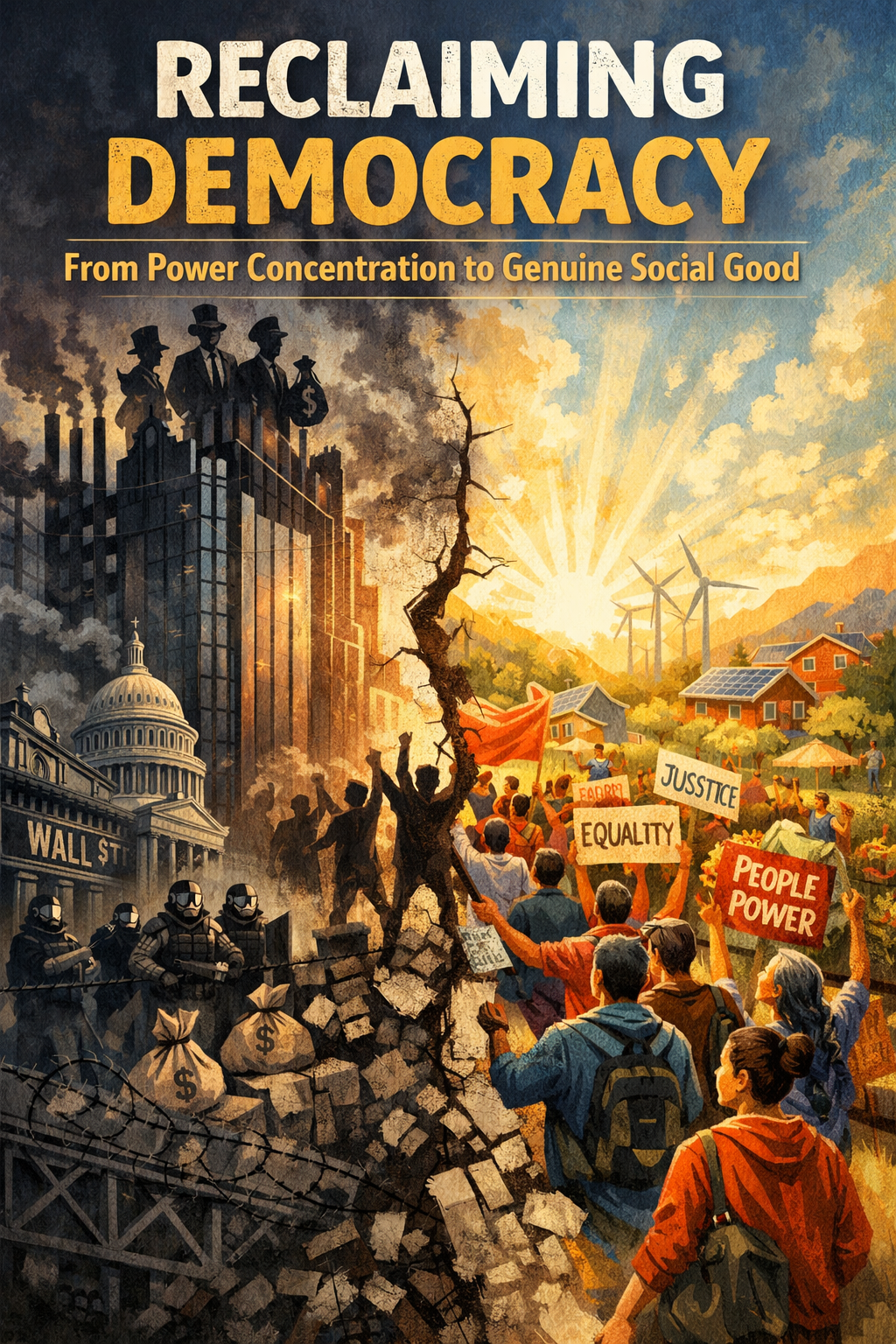
Across democracies, a troubling pattern has become increasingly clear: major political parties, once envisioned as vehicles for collective progress, have gradually transformed into power-centric institutions. Decision-making has become concentrated in the hands of a few, driven less by public welfare and more by electoral dominance, personal gain, and long-term control. In this shift, the original purpose of political social good has been diluted, and in many cases, replaced by exploitation masked as governance.
Large political parties today often function like rigid hierarchies. Local realities, minority voices, and grassroots concerns are filtered, reshaped, or ignored entirely to fit national narratives and power strategies. Policies are frequently crafted not because they are right or necessary, but because they are politically convenient. Social issues become tools for vote banks, not problems to be genuinely solved. This concentration of power creates distance, distance between decision-makers and the lived realities of the people they claim to represent.
The cost of this distance is borne disproportionately by local communities and minorities. Their needs are complex, contextual, and deeply rooted in local conditions. Yet these needs are routinely sidelined because they do not align with the broader interests of party leadership or national power play. When politics becomes a game of scale and dominance, the most vulnerable are reduced to statistics, slogans, or temporary promises.
What is urgently needed is a structural and cultural shift: a move away from centralized party control toward independent, accountable, and locally grounded social leadership.
Independent local social workers, activists, and decision makers especially those rooted in minority and marginalized communities offer a powerful alternative. Unlike party-appointed representatives, their legitimacy does not come from party loyalty or funding, but from trust, proximity, and lived accountability. They are answerable not to distant leadership councils, but to the people they serve every day.
Such individuals are not driven by political gain, career advancement, or ideological obedience. Their motivation is social uplifting, measured not in election cycles but in tangible improvements to lives education accessed, dignity restored, livelihoods protected, and voices heard. Their independence allows them to make decisions based on context and conscience, rather than party directives or strategic compromises.
Equally important is their freedom from interference. When local decision-makers are unhindered by party interests at large, they can act decisively and ethically. They can challenge harmful policies, adapt solutions to real conditions, and prioritize long-term community well-being over short-term political optics. This is not idealism, it is practical governance rooted in reality.
True democracy does not require stronger parties; it requires stronger communities. It thrives when power is distributed, not hoarded. When accountability flows upward from the people, not downward from party elites. When leadership is defined by service, not control.
Reclaiming social good from political exploitation means reimagining who holds power and why. It means investing trust and resources in independent, local, and minority-focused social workers who are empowered to act honestly, transparently, and autonomously. It means valuing integrity over influence, and outcomes over optics.
Only by decentralizing power and restoring decision-making to those closest to the problems can politics return to its original purpose: the collective uplifting of society, not the consolidation of power.
By - Pemson Pereira