
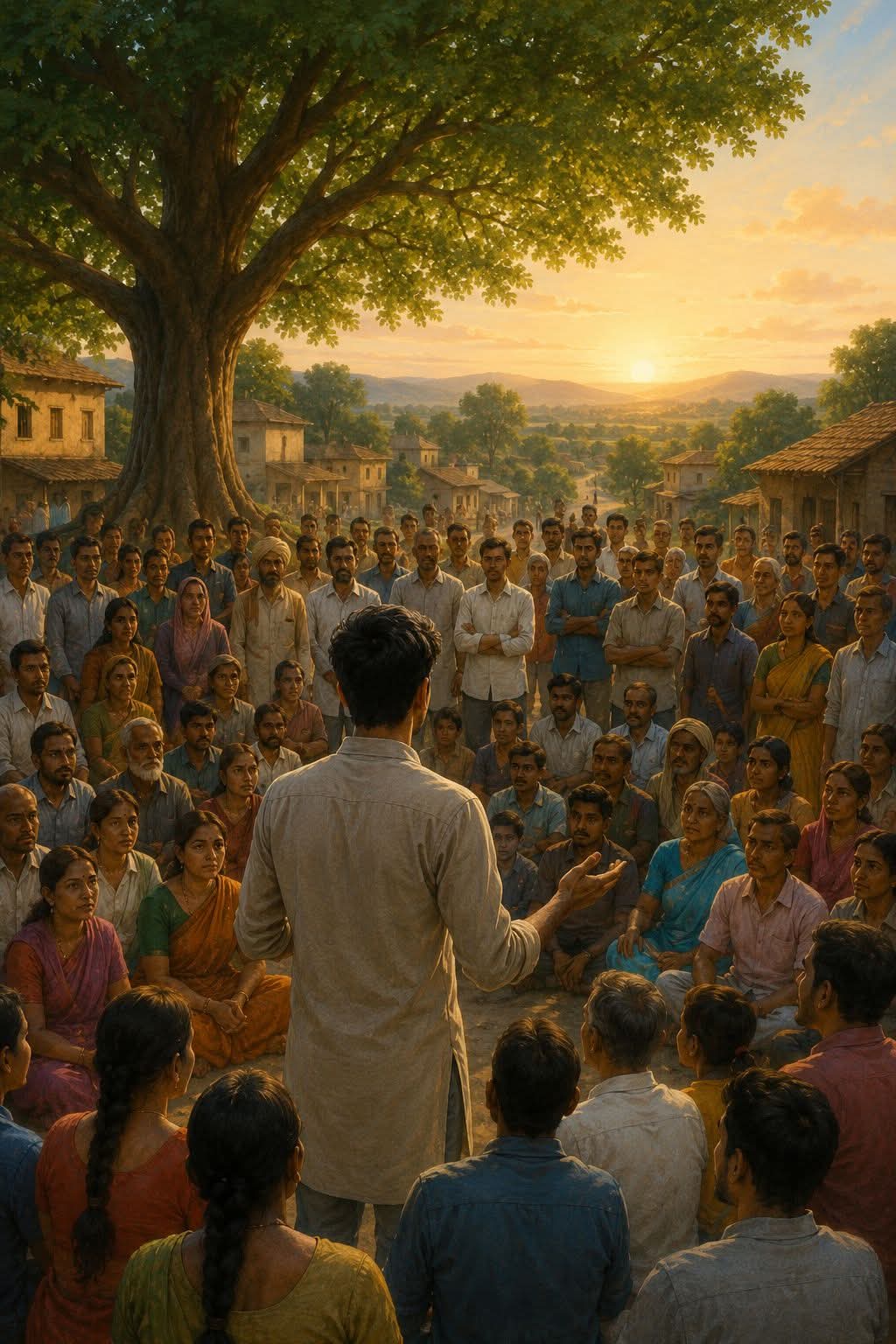
Across India, many citizens are beginning to question whether national political parties still represent the realities of ordinary people. Elections are increasingly shaped by central leadership, media narratives, party funding, and ideological battles that often feel disconnected from the everyday struggles of local communities.
Whether it is unemployment, power cuts, water shortages, rising living costs, poor roads, healthcare access, quality education, affordable housing, or local corruption, the people most affected by these issues are rarely the ones shaping political decisions. Instead, candidates are frequently selected by top party leadership based on loyalty, electoral calculations, party strategy and Investments rather than genuine grassroots accountability.
This growing concentration of political power weakens democracy. When decision-making flows only from the top, local voices become secondary. Communities are expected to follow party lines even when those priorities do not reflect their real needs.
Citizens should ask a simple question before voting: Does this candidate truly know and represent the people of this constituency, or are they primarily representing the interests of a national party structure?
A healthy democracy cannot survive on slogans alone. It requires accountability that is personal, visible, and grounded in the daily lives of citizens. That accountability is often strongest at the local level.
Independent candidates and genuinely community-rooted local representatives can offer an alternative to centralized political control. Unlike candidates heavily dependent on national party leadership, independent representatives are often directly answerable to the people who elected them. Their survival in public life depends less on pleasing party elites and more on maintaining trust within their own communities.
Voting locally does not mean voting based on religion, caste, wealth, language, or social status. It means choosing individuals who understand the realities of the people around them and who are willing to represent every citizen fairly and without prejudice.
The goal should not be blind loyalty to any political alliance whether NDA, INDIA, or any other national formation. Democracy works best when power is distributed, questioned, and held accountable. Citizens should never feel obligated to support leaders simply because they belong to large political structures.
Too often, national politics turns elections into emotional battles designed to divide people into camps. Meanwhile, local concerns remain unresolved year after year. Roads remain broken, public services deteriorate, corruption survives, and ordinary citizens continue struggling while political branding grows stronger.
Real democratic strength begins from the ground up. Strong villages, towns, municipalities, wards, and local institutions create stronger states and a stronger nation. When communities elect representatives they personally know, interact with, and can question directly, governance becomes more transparent and responsive.
Independent and local candidates are not automatically better simply because they are outside major parties. They too must be evaluated carefully. Voters should examine:
Their integrity and public record
Their accessibility to ordinary citizens
Their understanding of local issues
Their ability to work constructively without hatred or division
Their commitment to fairness across religious, economic, and social backgrounds
Their willingness to remain accountable after elections
Democracy is healthiest when citizens think independently rather than voting mechanically along party lines. No political party should become so dominant that people stop questioning it. Concentrated political power regardless of ideology always risks weakening accountability.
This election should therefore be viewed not merely as a contest between parties, but as a choice about the kind of democracy citizens want:
A system controlled primarily from the top down
Or a system where local communities regain meaningful influence over governance
The future of democratic representation depends on citizens reclaiming their voice from centralized political machinery. Vote for individuals who will stand with the people, remain accessible after elections, and represent the real needs of the community not merely the directives of distant party leadership.
A stronger democracy begins when power returns closer to the people.