
Understanding Electricity Load Enhancement in Goa: Avoiding Penal Charges Through Proper Sanctioned Load
Many households in Goa are now receiving penal electricity charges because their actual electricity usage exceeds the sanctioned load approved by the Goa Electricity Department. With rising usage of air conditioners, geysers, refrigerators, washing machines, pumps, and other high-power appliances, older domestic connections with low sanctioned loads are no longer sufficient for modern homes.
A practical solution is to apply for a Load Enhancement through the Goa Electricity Department. This process increases the officially approved electrical load for your premises and helps prevent recurring penalty charges on electricity bills.
The process may appear technical initially, but in practice it is a straightforward administrative and electrical verification procedure involving:
- Load calculation
- House wiring inspection
- Wiring diagram preparation
- Contractor certification
- Submission to the Electricity Department
- Approval by the Assistant Engineer
- Payment of enhancement fees
Why Penal Charges Are Being Applied
The Electricity Department monitors whether your actual connected load exceeds the sanctioned load.
For example:
- Existing sanctioned load: 0.24 kW
- Actual household usage: AC + geyser + fridge + fans + lights + appliances
- Real simultaneous demand: Often 3 kW to 5 kW+
When this mismatch occurs, the department may apply:
- Penal demand charges
- Excess load penalties
- Notices for load enhancement
- Possible safety concerns regarding wiring capacity
In this example, the sanctioned load was enhanced to approximately 4.84 kW, which is far more suitable for a modern household using an air conditioner and multiple appliances.
Practical Meaning of Sanctioned Load
Sanctioned load is not about the total number of appliances in your house.
It is based on:
Simultaneous Usage
The department estimates how many appliances may run together at the same time.
Example:
| Appliance | Approx Wattage |
|---|---|
| 1 Ton AC | 1200–1800 W |
| Geyser | 2000 W |
| Refrigerator | 200–500 W |
| Ceiling Fan | 60–80 W |
| LED Light | 9–20 W |
| Washing Machine | 500–1000 W |
| Microwave | 1200 W |
| Water Pump | 750–1500 W |
If you simultaneously use:
- AC → 1500 W
- Geyser → 2000 W
- Fridge → 300 W
- Fans/Lights → 500 W
Total live load:
1500 + 2000 + 300 + 500 = 4300\text{ W}
That means your practical demand is already about 4.3 kW.
A sanctioned load of only 0.24 kW or 1 kW would clearly be insufficient.
Step-by-Step Process for Load Enhancement in Goa
Step 1: Prepare a List of Electrical Appliances
The first step is creating a complete inventory of electrical items in the house.
Typical items include:
- Lights
- Fans
- 6A plug points
- 16A plug points
- Air conditioners
- Refrigerator
- Washing machine
- Geyser
- Water pump
- Microwave
- TV
- Kitchen appliances
The contractor calculates approximate wattage and prepares the load sheet.
In this example the contractor report:
- 16 light points
- 5 fan points
- 13 plug points
- AC connection
- Earthing details
- Wiring specifications
were included as part of the official documentation.
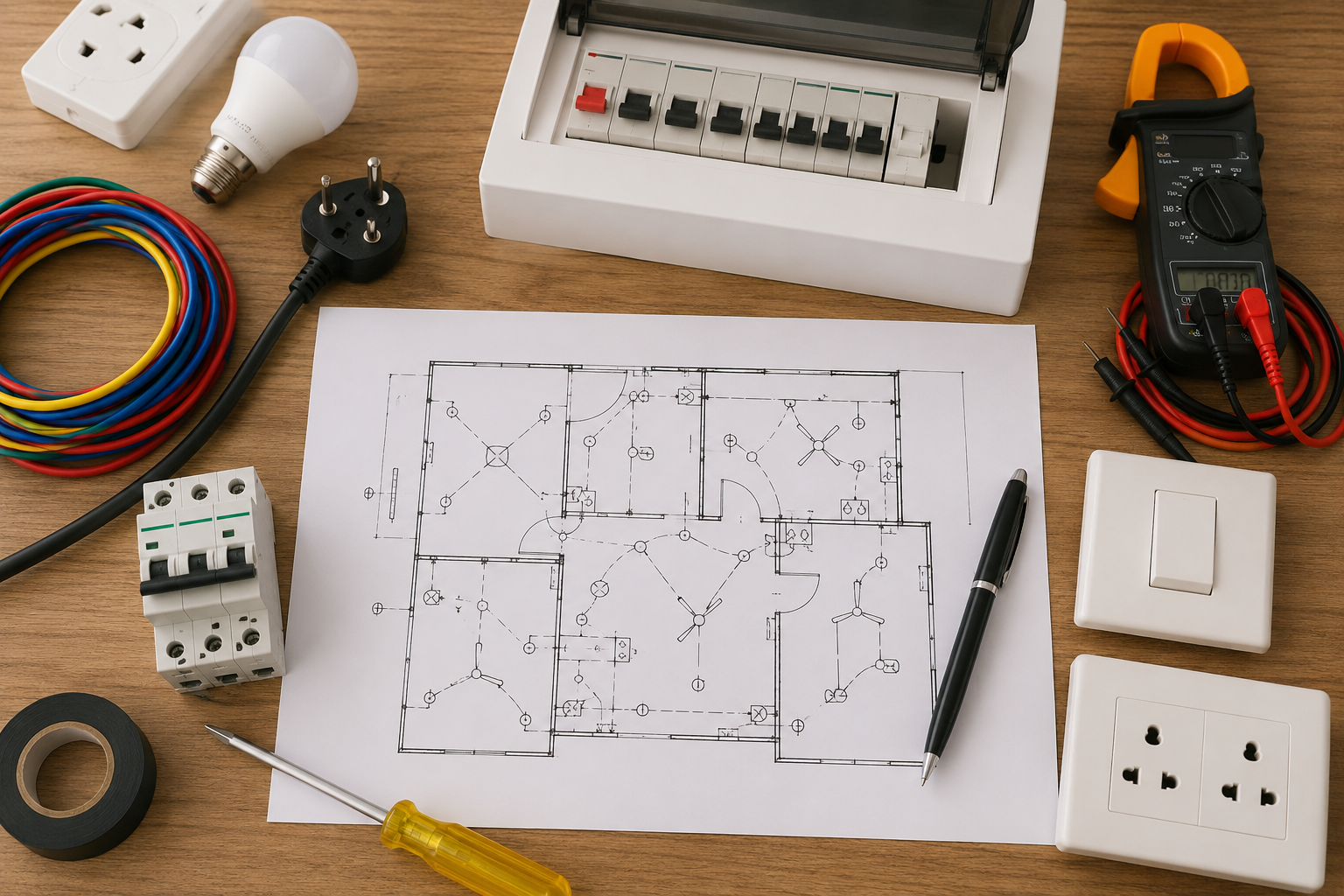
Step 2: House Wiring Diagram Preparation
A wiring diagram is prepared showing:
- Light points
- Fan points
- 6A plug points
- 16A power points
- Distribution board
- Earthing
- AC point
- Tube lights
This diagram is important because:
- It verifies actual electrical infrastructure
- Helps assess safety
- Confirms wiring adequacy
- Supports sanctioned load approval
Step 3: Inspection by Licensed Electrical Contractor
A licensed Goa government-authorized electrical contractor must:
- Inspect the premises
- Verify wiring condition
- Confirm safety standards
- Calculate total connected load
- Prepare test report
- Sign and stamp documents
The contractor usually provides:
- Wiring diagram
- Test report
- Completion certificate
- Load calculations
- Earthing certification
Typical contractor charges in Goa currently range around:
- ₹1,500–₹3,000
- Commonly about ₹2,000 for standard domestic applications
This usually includes:
- Site visit
- Drawing preparation
- Load calculation
- Department paperwork
- Contractor seal and signature
Step 4: Fill the Load Enhancement Application
The Goa Electricity Department requires the official:
“Application Form – Load Enhancement / Load Reduction”
The uploaded Annexure VII form includes fields for:
- Applicant name
- Service connection number
- Existing sanctioned load
- Enhanced load requested
- Reason for enhancement
- List of connected equipment
Step 5: Online Filing Through Goa Online Portal
Consumers may apply online through the Goa Online Portal.
Typical process:
- Login using OTP
- Select Electricity Services
- Choose Load Enhancement
- Enter CA Number
- Upload documents
- Submit application
- Pay fees
- Receive acknowledgment and tracking reference
Documents commonly required:
- Latest electricity bill
- ID proof
- Wiring completion certificate
- Contractor test report
- Wiring diagram
- Property/occupancy proof
- Passport-size photograph
Step 6: Offline File Submission
Even after online filing, physical verification is commonly required.
The completed file is submitted at the local subdivision office.
Example offices:
- Margao
- Aquem
- Cuncolim
- Ponda
- Panjim
- Mapusa
The file is reviewed by:
- Junior Engineer
- Assistant Engineer
The Assistant Engineer verifies:
- Load calculations
- Wiring safety
- Contractor license
- Earthing
- Meter compatibility
The uploaded documents include official acknowledgment and engineering office stamp after verification.
Step 7: Government Fees for Load Enhancement
After approval, the department calculates enhancement charges.
These vary depending on:
- Existing load
- Requested load
- Meter category
- Domestic/commercial status
For a residential increase to approximately 4.5–5 kW, consumers commonly report charges around:
- ₹3,000–₹5,000
- Often around ₹3,500 in practical cases
This is separate from contractor fees.
Step 8: Approval and Bill Update
After approval:
- Sanctioned load is officially updated
- Electricity billing profile changes
- Penal charges stop
- Future bills reflect new sanctioned demand
Consumers should verify the next electricity bill carefully to confirm:
- New sanctioned load appears correctly
- No further penalty charges are applied
Importance of Proper Wiring and Earthing
Load enhancement is not merely paperwork.
Higher loads require:
- Proper wire gauge
- Safe MCBs
- Adequate earthing
- Correct distribution boards
The uploaded contractor report references:
- PVC insulated copper wiring
- Earthing rod installation
- MCB specifications
- Distribution board safety
Improper wiring with high sanctioned loads can create:
- Fire hazards
- Overheating
- Voltage drops
- Appliance damage
Common Signs You Need Load Enhancement
You should consider load enhancement if:
- You installed an AC recently
- Your bill shows penalty charges
- MCBs trip frequently
- Voltage fluctuates under load
- You added geysers or heavy appliances
- Multiple large appliances run together
- Your sanctioned load is still below 1 kW in a modern household
Approximate Practical Household Load Estimates
| Household Type | Recommended Load |
|---|---|
| Small basic home | 1–2 kW |
| Standard family home | 3–5 kW |
| Home with AC + geyser | 4–6 kW |
| Multiple ACs | 6–10 kW |
Conclusion
Electricity consumption patterns in Goa have changed significantly over the years. Older sanctioned loads designed for basic lighting and fans are no longer adequate for homes using modern appliances like air conditioners, geysers, pumps, and kitchen equipment.
Load enhancement is increasingly becoming both:
- a regulatory necessity, and
- a practical safety measure.
The process involves:
- Listing household electrical items
- Preparing wiring diagrams
- Contractor inspection and certification
- Filing the application
- Government verification
- Paying enhancement fees
- Receiving updated sanctioned load approval
Although the process involves some paperwork and expenses, it helps households:
- avoid recurring penal charges,
- improve electrical safety,
- maintain regulatory compliance,
- and support modern electricity usage requirements sustainably.