
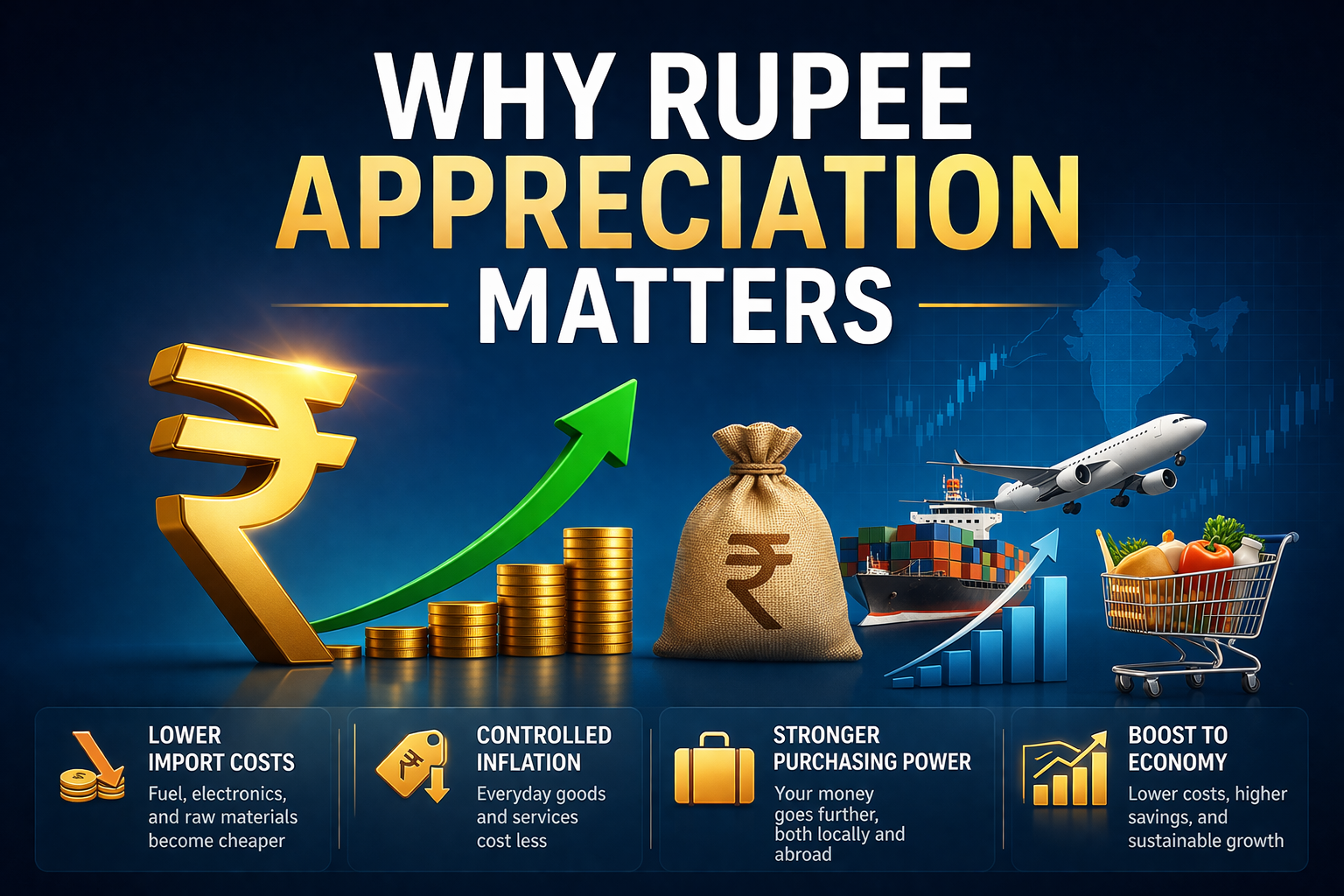
The discussion around currency valuation often remains confined to financial experts, policymakers, and market analysts. However, the appreciation of the Indian Rupee is not an abstract macroeconomic concept, it has tangible, everyday implications for citizens, businesses, and the nation’s long-term development trajectory. It influences purchasing power, inflation, trade competitiveness, and economic sovereignty. Given its significance, the question is not merely whether Rupee appreciation matters, but how it can be responsibly achieved and sustained through deliberate, structured interventions.
At its core, currency appreciation refers to an increase in the value of a nation’s currency relative to others. For India, a stronger Rupee implies that imports become cheaper, foreign debt becomes less burdensome, and citizens enjoy higher purchasing power. In theory, this could translate into lower costs for essential goods like fuel, electronics, fertilizers, and even food items that are indirectly affected by global commodity prices. The idea that a meal costing Rs 200 today could cost Rs 50 in the future is rooted in this logic. However, such an outcome depends on a complex interplay of factors, and without systemic reforms, it risks being more aspirational than realistic.
To understand whether such a scenario is feasible, it is necessary to examine the key drivers of currency appreciation.
First, productivity and economic output play a central role. A country that produces high-value goods and services particularly in sectors with global demand naturally strengthens its currency. India’s Information Technology sector has already demonstrated this effect by generating consistent foreign exchange inflows. However, the next phase must involve deeper integration of automation, artificial intelligence, and high-value manufacturing. Automation is not merely about replacing labor; it is about increasing output efficiency, reducing costs, and enhancing global competitiveness. When Indian firms can produce more with fewer inputs and maintain quality standards, export earnings rise, strengthening the Rupee.
Second, energy independence is a critical but often under emphasized factor. India remains heavily dependent on imported crude oil, which exerts constant downward pressure on the Rupee. Every spike in global oil prices translates into higher import bills and currency depreciation. Therefore, strategic investments in renewable energy solar, wind, green hydrogen and domestic energy infrastructure are not just environmental priorities but macroeconomic necessities. A sustained reduction in energy imports would directly improve the trade balance and support currency appreciation.
Third, inflation management must be handled with scientific precision. Persistent inflation erodes the real value of a currency. If domestic prices rise faster than those of trading partners, the currency weakens in real terms, even if nominal exchange rates remain stable. This requires a data-driven approach to monetary policy, where interest rates, liquidity measures, and fiscal coordination are aligned with inflation targets. Importantly, inflation control should not rely solely on tightening demand but also on improving supply chains, reducing inefficiencies, and enhancing agricultural productivity.
Fourth, diversification of resources and investment in alternative materials and technologies are essential. For instance, reducing dependence on imported semiconductors, rare earth metals, and critical industrial inputs through domestic research and innovation can significantly improve economic resilience. Public and private investment in research and development must be treated as a long-term strategic asset rather than a discretionary expense.
Despite these pathways, there are important trade-offs that must be acknowledged. A rapidly appreciating currency can harm export competitiveness by making Indian goods more expensive in global markets. This is particularly relevant for labor-intensive sectors such as textiles, handicrafts, and small-scale manufacturing. Therefore, the objective should not be unchecked appreciation but a stable, gradually strengthening currency aligned with productivity gains.
Moreover, the idea that a Rs 200 meal could drop to Rs 50 requires careful scrutiny. While currency appreciation can reduce the cost of imported inputs such as fuel and certain food items domestic factors like wages, rents, logistics, and taxes also play a significant role in pricing. Unless there is a simultaneous increase in productivity and efficiency across the supply chain, such drastic price reductions are unlikely. In fact, rising incomes and improved living standards may lead to higher, not lower, nominal prices, even if real purchasing power increases.
This distinction between nominal prices and real purchasing power is crucial. What truly matters is not whether prices fall dramatically, but whether citizens can afford more with their income. If wages grow faster than prices, even stable or slightly increasing prices can result in improved living standards.
Given these complexities, the role of government becomes central. Passive reliance on market forces is insufficient. What is required is a coordinated policy framework that actively promotes Rupee strength through sector-specific initiatives.
In the energy sector, this could involve accelerated deployment of renewable projects, incentives for domestic manufacturing of energy equipment, and strategic reserves to cushion against global price shocks. In the IT and automation sectors, policies should encourage innovation, skill development, and adoption of advanced technologies across industries not just within the tech sector.
Additionally, regulatory reforms that reduce bureaucratic friction, improve ease of doing business, and enhance transparency can attract foreign investment, further supporting the currency. However, such inflows must be stable and long-term, rather than speculative, to avoid volatility.
Institutional accountability is equally important. Policy measures must be evaluated based on measurable outcomes trade balance improvement, inflation stability, productivity growth rather than political narratives. Public trust in economic management is itself a factor that influences investor confidence and currency stability.
From a long-term perspective, Rupee appreciation should be seen as a byproduct of structural strength rather than an isolated policy goal. Countries with strong currencies such as those with advanced manufacturing, technological leadership, and stable institutions did not achieve this through short-term interventions but through sustained, multi-decade strategies.
In conclusion, Rupee appreciation matters because it directly impacts economic sovereignty, citizen welfare, and national resilience. While the vision of significantly lower prices captures public imagination, it must be grounded in realistic expectations. Achieving a stronger Rupee requires coordinated action across energy independence, technological advancement, inflation management, and resource diversification. It demands active government involvement, but also disciplined execution and institutional integrity.
The question is not whether we can make a Rs 200 meal cost Rs 50, but whether we can build an economy where such a meal becomes easily affordable without compromising quality of life or economic stability. That is a more meaningful and achievable goal, one that aligns with both economic logic and human dignity.