
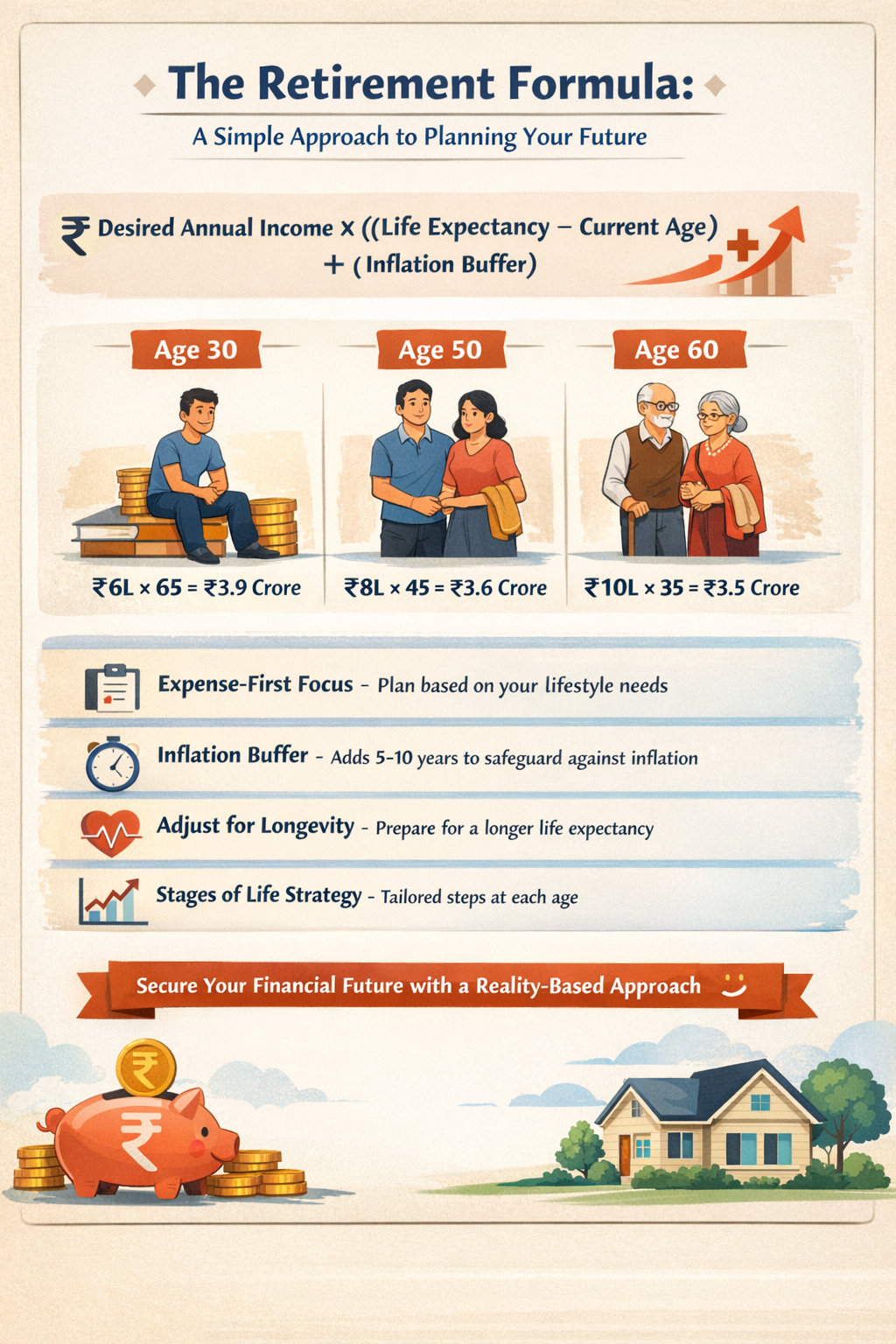
Retirement planning is often made unnecessarily complex by overreliance on optimistic return assumptions, volatile market forecasts, or generic rules of thumb. In reality, retirement is not a financial product—it is a liability that must be funded with adequate certainty. A more robust approach begins by defining lifestyle requirements and translating them into a capital requirement using a simple, conservative formula:
Desired Annual Income × ((Life Expectancy − Current Age) + Inflation Buffer)
This formula reframes retirement planning as a consumption problem, not a speculative investment challenge. It anchors planning in human realities: how long you are likely to live, how much you need to live well, and how inflation erodes purchasing power over time. The added inflation buffer accounts for uncertainty in prices, healthcare costs, and longevity risk.
This article explains the logic behind the formula and demonstrates its application across three critical life stages: ages 30, 50, and 60.
Understanding the Formula Components
Before applying the formula, each component must be clearly understood.
1. Desired Annual Income
This is the real (inflation-adjusted) amount you want to spend annually during retirement. It should reflect:
- Housing and utilities
- Food and daily living
- Healthcare and insurance
- Transport and mobility
- Modest discretionary spending
This figure should be realistic, not aspirational. Overestimation leads to unnecessary capital hoarding; underestimation leads to dependency and stress.
2. Life Expectancy − Current Age
This represents the number of years your retirement corpus must support you. Conservative planning typically assumes a life expectancy of 85–90 years, especially given improvements in healthcare and lifestyle.
3. Inflation Buffer
An additional 5–10 years is added to account for:
- Inflation uncertainty
- Medical cost escalation
- Market underperformance
- Longevity beyond averages
This buffer is the difference between theoretical planning and resilient planning.
Why This Formula Works
Most retirement models fail because they:
- Depend heavily on assumed returns
- Ignore behavioral and health risks
- Underestimate inflation impact
This formula avoids those pitfalls by:
- Starting with expenses, not returns
- Treating retirement as a long-term liability
- Forcing clarity on lifestyle choices
It does not replace detailed planning but provides a reliable baseline that can be stress-tested and refined.
Case Study 1: Age 30 — Time Is the Primary Asset
Profile
- Age: 30
- Life Expectancy Assumed: 90 years
- Desired Annual Income (today’s value): ₹6,00,000
- Inflation Buffer: 5 years
Calculation
Remaining years = (90 − 30) + 5 = 65 years
Required retirement corpus (real value):
₹6,00,000 × 65 = ₹3.9 crore
Interpretation
At age 30, the headline number may appear intimidating. However, this is where time works as leverage. With 25–30 years of accumulation ahead, even modest, disciplined investing can bridge the gap.
For example:
- Monthly investment of ₹25,000–₹30,000
- Real return assumption of 4–5%
- Gradual income growth
The critical insight here is not the corpus size, but the long runway. Small deviations today compound massively over decades.
Strategic Focus at 30
- Maximize savings rate, not returns
- Invest in skill and income growth
- Accept short-term volatility
At this stage, retirement planning is less about retirement and more about career resilience and habit formation.
Case Study 2: Age 50 — Risk Management Becomes Central
Profile
- Age: 50
- Life Expectancy Assumed: 90 years
- Desired Annual Income: ₹8,00,000
- Inflation Buffer: 5 years
Calculation
Remaining years = (90 − 50) + 5 = 45 years
Required retirement corpus:
₹8,00,000 × 45 = ₹3.6 crore
Interpretation
At age 50, the challenge shifts. Time is no longer abundant, and errors are more costly. Many individuals at this stage face:
- Peak expenses (education, housing)
- Health risks emerging
- Career uncertainty
The formula reveals a key truth: retirement affordability is primarily a function of lifestyle control, not returns.
If ₹3.6 crore feels unreachable, reducing annual retirement spending by ₹1 lakh reduces required corpus by ₹45 lakh.
Strategic Focus at 50
- Reduce lifestyle inflation aggressively
- Prioritize capital preservation
- Eliminate high-interest liabilities
- Increase allocation to stable income assets
This is also the stage where healthcare planning becomes non-negotiable.
Case Study 3: Age 60 — Capital Protection Over Growth
Profile
- Age: 60
- Life Expectancy Assumed: 90 years
- Desired Annual Income: ₹10,00,000
- Inflation Buffer: 5 years
Calculation
Remaining years = (90 − 60) + 5 = 35 years
Required retirement corpus:
₹10,00,000 × 35 = ₹3.5 crore
Interpretation
At age 60, growth assumptions become dangerous. The retirement corpus must already exist or be very close to completion. There is limited scope for recovery from market drawdowns.
At this stage:
- Lower spending flexibility
- Higher medical costs
- Psychological need for certainty
The formula acts as a reality check, not a motivational tool.
Strategic Focus at 60
- Shift from accumulation to distribution
- Maintain inflation-linked income
- Avoid capital erosion
- Preserve liquidity
The objective is not maximizing returns but ensuring predictable cash flow for decades.
Inflation Buffer: The Most Underestimated Variable
Many retirement plans fail not because returns are poor, but because inflation quietly compounds over time. A 6% inflation rate halves purchasing power roughly every 12 years.
The inflation buffer:
- Protects against optimistic assumptions
- Absorbs healthcare cost spikes
- Accounts for longevity surprises
In conservative planning, this buffer is what separates sufficiency from fragility.
Comparing With Traditional Retirement Rules
| Method | Core Weakness |
|---|---|
| 4% Rule | Assumes stable markets |
| X-times salary | Ignores lifestyle |
| Target corpus guessing | Emotion-driven |
| Return-first models | Fragile assumptions |
The proposed formula is expense-first, human-centric, and adaptable across income levels.
Key Insights Across All Ages
- Retirement is an expense problem, not an investment problem
- Lifestyle choices matter more than returns
- Inflation is the silent destroyer of plans
- Earlier clarity reduces future sacrifice
- Simpler models improve execution
Final Perspective: Retirement as Financial Dignity
Retirement planning is ultimately about autonomy and dignity, not luxury. The formula:
Desired Annual Income × ((Life Expectancy − Current Age) + Inflation Buffer)
forces honest reflection on:
- How much is “enough”
- What trade-offs matter
- When to prioritize security over growth
Used correctly, it transforms retirement from a vague future worry into a measurable, manageable objective—one that can be revisited, adjusted, and strengthened at every stage of life.
The goal is not to predict the future perfectly, but to prepare robustly for uncertainty.
For Free Financial Consultation Call us on +91 8329931191
or email us on [email protected]